
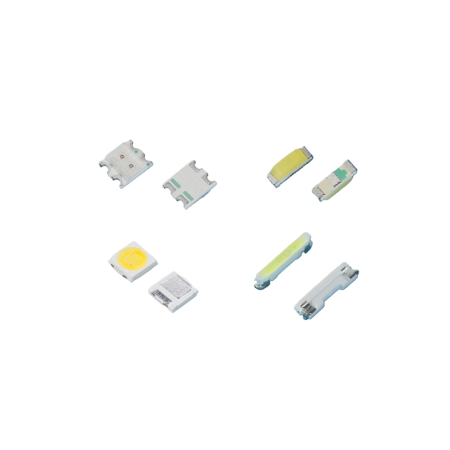
Light-emitting diode (LED)
A light-emitting diode (LED) is a special type of diode that converts electrical energy directly into light energy when an electric current passes through it, thus emitting light.Unlike traditional light bulbs that emit light through heat (incandescent bulbs), LEDs are solid-state light sources whose light-emitting principle is based on the properties of semiconductor materials.
Key features and advantages
-
High energy efficiency:LEDs directly convert electrical energy into light energy with extremely low heat loss, making them much more efficient than traditional incandescent bulbs.
-
Long lifespan:LEDs have no filament, are not easily burned out, and have a lifespan of tens of thousands or even hundreds of thousands of hours, far exceeding that of incandescent and fluorescent lamps.
-
Small size:LED's small size makes it highly flexible in design, allowing it to be used in various small spaces or uniquely shaped products.
-
Fast response time:LEDs can switch on and off rapidly in microseconds, making them suitable for applications that require rapid flashing, such as traffic signals and brake lights.
-
Sturdy and durable:As a solid-state component, LEDs are resistant to vibration and impact, making them suitable for harsh environments.
-
Environmental friendly:LEDs do not contain harmful substances such as mercury, making them more environmentally friendly.
Application areas
Thanks to their superior performance, LEDs have been widely used in all aspects of daily life:
-
illumination:LED bulbs, lamps, streetlights, flashlights.
-
Monitor:LED TVs, computer monitors, and mobile phone screens.
-
Car:Headlights, taillights, brake lights, and instrument panel backlighting.
-
Signals and Instructions:Traffic lights, traffic lights, and appliance indicator lights.
-
Backlight:Backlight module of a liquid crystal display (LCD).
Environmental and Materials Regulations
RoHS: This is an EU directive that restricts the use of hazardous substances such as lead, mercury, cadmium, hexavalent chromium, polybrominated biphenyls (PBBBs), and polybrominated diphenyl ethers (PBDEs) in electrical and electronic equipment. All TVS components sold in the EU market must comply with RoHS standards.
REACH: This is another chemical management regulation in the European Union that ensures a high level of protection for chemical substances and requires companies to be responsible for the chemicals used in their products.