
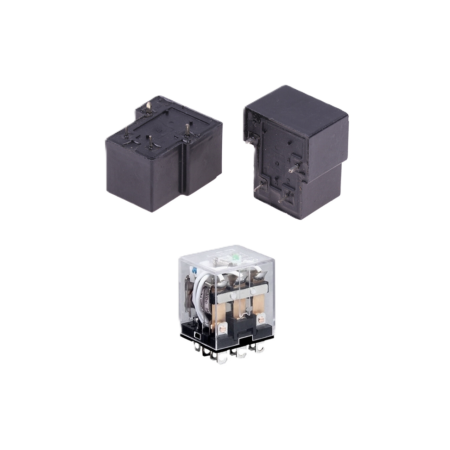
Power Relay
Power Relay is an electromagnetic switch primarily utilized to control high currents or high voltages within a circuit. Unlike standard miniature signal relays, power relays are specifically engineered to handle electrical currents ranging from several amperes to hundreds of amperes. Consequently, they feature a more robust structural design capable of enduring substantially greater electrical loads.
Operating
The operating principle of a power relay is similar to that of a conventional relay, consisting fundamentally of two sections: the control circuit and the load circuit.
-
Control Circuit: When a low-magnitude current passes through the coil, it generates an electromagnetic field.
-
Load Circuit:This electromagnetic field attracts or repels a metallic component known as the armature.
-
Switching Actio:The mechanical movement of the armature actuates the contacts within the load circuit, causing them to close (normally open contacts) or open (normally closed contacts), thereby controlling the switching state of the load circuit.
Through this mechanism, users can safely control high-voltage, high-current loads using a low-voltage, low-current control signal.
Key Features and Applications
-
High-Current Control Capability:This is the core advantage of a power relay. It effectively isolates the control circuit from the load circuit, preventing high currents from flowing directly through control components, thereby protecting operators and sensitive circuitry.
-
Diverse Contact Configurations:Power relays are available in a wide variety of contact configurations (e.g., SPST, DPDT, etc.) to satisfy diverse switching requirements.
-
Robust Durability:They are typically engineered with thicker contacts and a more rugged structural design to withstand the high-current arcing and heat dissipation generated during switching operations.
Common Application Areas
-
Industrial Automation:Used to control large motors, heaters, and heavy industrial machinery.
-
Automotive Electronics:Controls high-power devices in vehicles, such as headlights, HVAC compressors, power windows, and fuel pumps.
-
Home Appliances:Regulates compressors or heating elements in products like air conditioners, refrigerators, and washing machines.
-
Power Systems:Deployed in Uninterruptible Power Supplies (UPS) or power inverters to switch to backup power sources or control high-voltage circuits.
-
Renewable Energy:Used in solar power systems to control inverters or handle DC circuit switching.
Power relays serve as the critical bridge connecting low-current control circuits with high-current load circuits. Their exceptional reliability and safety make them indispensable in applications requiring high-power control.